Education in Victorian Britain

Updated: Jul 10, 2018
By Cameron

Education in Victorian England
Education in Victorian England is more complicated than one would expect. This is because it was a time of great upheaval and change for the education system. Before this time only the rich boys were guaranteed an education; girls were expected to marry an educated man and therefore weren't given the opportunity, and the poor kids could not afford it and, in many cases, worked to provide a little more income for their family. In 1870 laws were put in place that mandated that all children had to attend school. But with this law, hardships came. For example, there were just not enough schools, especially for the poorer families. There were also no inspectors and trainers for schools so it was almost impossible to see if children were really learning.
Education was still a work in progress even after these problems were addressed. Teachers were strict and, many times, doled out punishments unfit for children. No one could write with their left hand and students were forced to sit in a corner with a 'dunce' hat if they could not understand the teaching. Any student who could not keep up was deemed naughty, even if they were trying. As time went on, women began having other education opportunities. Women's colleges began opening up, many of which elevated the job of governess to a reputable career. Before this time governesses were mostly poorer women or rich women who were unable to marry.
The Role of Education in Jane Eyre
Now, with a solid foundation of what the education system looked like in Victorian England, we can think about how this connects to Jane Eyre. We know that Jane works as a governess more than once; in fact it could be considered her career towards the end of the novel. This occupation isn't written in a light that would deem it unfavorable. In fact, Mr. Rochester falls in love with her during her occupation as governess in his household. This is an interesting theme to consider, since Jane Eyre was published in 1847 and schooling was not mandatory until 1870. It adds another layer to Rochester's character, though certainly doesn't negate all of his negative qualities.
Education, for Jane, is a path out of her situation. This is apparent from the beginning of the novel, when she is not allowed to go to school at Mrs. Reed's. She is then moved to a charity boarding school and, as we know from the novel as well as facts of the time, they were ill inspected and therefore many of the girls died or were starved out. It is important to understand that, even in these conditions, Jane having an education opportunity instead of being forced to work was still a prospect many young girls, especially poorer girls, were given.
When she is given a school house later in the novel it can be easier understood why she did not like her job. The children were undereducated, yes, but it is also possibly that they were learning impaired in any respect (even if this respect includes writing with one's left hand). She is almost considered to be running a Dame school, which was a school run by a local woman out of one room in her house. This type of school was not ideal, since the Dame would usually cram as many students as she could into one room, and they ended up being all different ages and education levels.
Education throughout the novel is seen as a privilege for Jane; it gives her a job, it gives her happiness (through her reading), and it gives her a chance at love (since Mr. Rochester seems to constantly swoon over her intelligence, though this same intelligence bites him when she refuses to play ignorance and run away with him).
Related links:
- http://www.victorian-era.org/childrens-education-in-victorian-era.html
- http://www.simplehistory.co.uk/time-travel/education-victorian-britain/
- https://victorianchildren.org/victorian-schools/
- https://www.bl.uk/victorian-britain/articles/education-in-victorian-britain
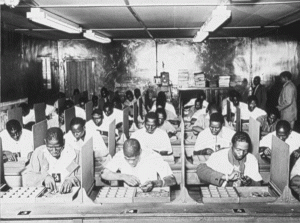
Photo taken from: http://www.victorian-era.org/childrens-education-in-victorian-era.html

Comments