Missionary Work in the 19th Century British Empire

Updated: Jun 11, 2018
By Virginia Langhammer

Women in Missionary Work
Missionary work is one of the most relevant themes of the colonial period addressed in Charlotte Brontë's Jane Eyre. Even though the theme of missionary work is only presented in a short part of the novel, it is still very pertinent, since it reveals an important historical background, which is the relationship between the British Empire and the colonies. When we talk about missionary work, we are talking about the introduction of English education and religion into the colonies, as a way of imposing the Empire's values and ideologies. Jane Eyre brings up the idea of women working as missionaries in British colonies, which is the main subject that I wish to discuss in this post.
Missionary Wives
Unable to work as missionaries in their own right, women engaged in missionary work as missionaries' wives, who played an important role in the education of native women and girls. In her article, "Can Women Be Missionaries?", Clare Midgley says, "Wives were seen as providing an important domestic base for their husbands and as modeling proper feminine domesticity to indigenous women. ... [T]hey were also recognized as playing an important role in the development of girls’ education." (Midgley 339). Here, Midgley is referring to places like India, where sexual segregation made the presence of missionary women essential if they were to teach women and girls (Midgley 340). Later, missionary societies started recruiting single women to go to the colonies as "agents" - not missionaries - but "it was still very difficult for single women to overcome familial objections to engage in such work" (Midgley 348). For this reason, missionaries’ wives represent the most relevant participation of women in missionary work in the 19th century.
Female Missionary Memoirs
By the same time Jane Eyre was published (1847), a new genre of female missionary memoirs emerged. Interestingly, these memoirs were usually posthumous publications, edited and published by the husband of these women. The memoir of the American missionary Mrs. Harriet Newell was the first one of the kind to be published in England in 1815; the memoir of the British-born Elizabeth Harvard was published in 1825, and many others were published after that (Midgley 341-343). Midgley says, "The memoirs were often framed by a substantial introduction by the bereaved husband or by another male supporter of missions explaining the reasons for publication and suggesting how the memoir should be read as an example to other women, encouraging them to take up the missionary cause" (Midgley 341). Ultimately, these memoirs acted as propaganda of missionary work, and encouraged other women to either marry missionaries or try to work as agents in missionary schools themselves.


Missionary Work in Jane Eyre
In Jane Eyre, the missionary St. John Rivers desires to bring a wife with him to India to help him with his mission. For Mr. Rivers, Jane's education and character makes her a good fit for the role of a missionary wife. This is what he says in his proposal: "Jane, come with me to India: come as my helpmate and fellow-labourer... God and nature intended you for a missionary's wife. It is not personal, but mental endowments they have given you: you are formed for labour, not for love. A missionary's wife you must - shall be. You shall be mine: I claim you - not for my pleasure, but for my Sovereign's service" (Brontë 464). In John's words we see his cold and severe nature. He thinks that Jane would be a good missionary wife because of her "good nature", which implies her humbleness and lack of vanity. Also, she is already used to hard work, which is a useful trait for a missionary wife. He implies that missionary work is a kind of "warfare" against paganism. Accordingly, his marriage proposal is a kind of "enlistment" rather than a romantic proposal. This passage of Jane Eyre portrays women in missionary work with the role of a "helpmate", which suggests subordination to the husband while also implying that the wife would be fulfilling an important mission in the service of God.
Works Cited
Brontë, Charlotte. Jane Eyre. Penguin, 2006.
Midgley, Clare. “Can Women Be Missionaries? Envisioning Female Agency in the Early Nineteenth Century British Empire.” Journal of British Studies, vol. 45, no. 2, 2006, pp. 335–358. JSTOR, JSTOR, www.jstor.org/stable/10.1086/499791.
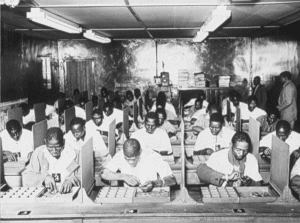
Photo taken from: http://what-when-how.com/western-colonialism/imperialism-gender-and-western-colonialism/

Comments